Table of contents
- A Community Built Around Water
- Why an Apartment Ensemble Changes the Map
- A Twenty-Year Pause Ends
- Comparable Repositioning Stories
- Connectivity Without Compromise
- Demographic Shifts and Buyer Profiles
- Nakheel’s Original Vision, Twenty Years On
- Lakes, Lights, and Lived Texture
- Schools, Services, and the Network of Daily Life
- The Long View
Few Dubai communities have aged as quietly as Jumeirah Islands. Built on a Nakheel masterplan in the early 2000s, the gated villa enclave has, for two decades, occupied an almost paradoxical position on the city’s residential map: globally recognisable to Dubai insiders, almost invisible to the broader luxury market. The arrival of a four-tower apartment ensemble at the community’s lakeside is not just a product launch. It is, by several measures, the most consequential intervention in the neighbourhood’s twenty-year history.
A Community Built Around Water
The original Jumeirah Islands masterplan, released by Nakheel in 2003, organised the community around forty-six landscaped islets connected by interlinked saltwater lakes. The land-to-water ratio was set at two to one, an unusual proportion for a Dubai community of its era and one that has shaped the neighbourhood’s character ever since. Each islet was sized to host a cluster of villas, with private mooring and lake frontage forming part of the planning logic.
Bayut’s area-guide coverage of Jumeirah Islands has consistently framed the community as one of Dubai’s most discreet upscale enclaves. Schools, retail, and community amenities have been concentrated within a closed loop of internal roads, and the gated entry has effectively limited transit traffic. JLL’s broader UAE Real Estate Market Overview has, in periodic notes on established communities, identified Jumeirah Islands as a low-velocity, high-conviction market where the buyer profile skews heavily toward end-users.
That stability has been the community’s defining strength. It has also, in commercial terms, been its limitation. Without apartment product, the community has been accessible only to villa buyers, a segment that has remained relatively narrow even within Dubai’s expanding luxury market.
Why an Apartment Ensemble Changes the Map
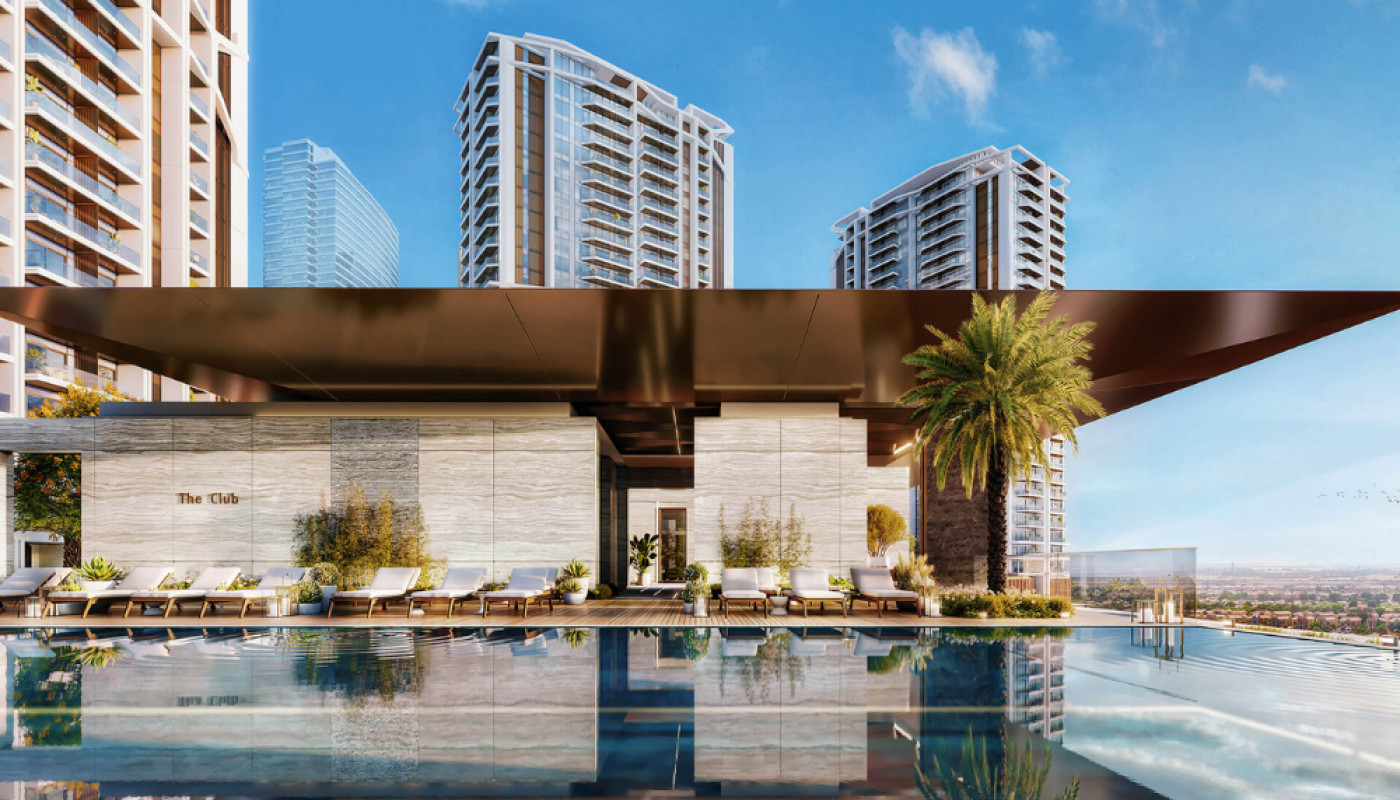
The introduction of Eltiera Views into Jumeirah Islands is not a marginal addition. The development comprises four interconnected towers, each rising twenty-six residential floors over a three-level podium, producing approximately 1,180 residences. The apartment mix begins at 796 sqft one-bedroom homes priced from AED 2.1 million and extends to penthouses of 5,509 to 5,985 sqft available on request.
This volume of apartment product, dropped into a community of finite villa supply, fundamentally changes who can access the address. Buyers who would not consider a freehold villa, either by lifestyle preference or by capital allocation, now have a route into the postcode. The repositioning effect is structural rather than cosmetic.
Knight Frank’s Dubai residential research has, in recent years, repeatedly highlighted the difference between communities with mixed typology and communities with single typology. Mixed-typology communities tend to demonstrate broader buyer absorption, more stable resale activity, and lower volatility through cycles. The introduction of apartments at Jumeirah Islands moves the neighbourhood from the single-typology to the mixed-typology category, with the secondary implications that classification carries.
The Lakeside Argument
The choice of lakeside positioning, rather than perimeter or road-facing, is itself a significant design and planning decision. Saltwater lake frontage at Jumeirah Islands has, for two decades, been an exclusively villa-side asset. By organising the four towers to face the lakes, Ellington’s Jumeirah Islands project places apartment buyers in direct visual relationship with the most distinctive feature of the masterplan, an experiential parity with villa residents that is rare in mixed-typology developments.
A Twenty-Year Pause Ends
For two decades, Jumeirah Islands has effectively been a closed loop. Nakheel has not released new plots in years, and the villa stock has traded among a small, established pool of buyers. The community has had no new development of note since its original delivery, and the visual character of the neighbourhood has remained stable enough that aerial photography from 2010 and from 2024 looks almost identical.
The arrival of four towers at the lakeside breaks that pause. It introduces vertical mass into a community that has been predominantly horizontal, and it adds new pedestrian, vehicular, and commercial flows to a planning logic that was originally optimised for villa traffic. Whether this introduction proves additive or disruptive will depend on execution, but the planning decision itself has been welcomed by area brokers consulted by Bayut as a long-overdue evolution of the community.
Comparable Repositioning Stories
Dubai has, in the past five years, seen a handful of comparable repositioning stories, where a single project has shifted the character of an established community.
The arrival of Ocean House on Palm Jumeirah introduced design-led apartments into a community that had been dominated by villas and large-format hotel-residences. The launch of Bulgari Lighthouse on Jumeirah Bay Island reframed that small enclave around an ultra-prime tower. Eltiera Heights on the Dubai Islands has been positioned, in industry commentary, as a similar marker for the new coastal district.
Eltiera Views joins that lineage, but with a specific distinction. Where Palm Jumeirah, Jumeirah Bay, and the Dubai Islands have all hosted prior apartment product, Jumeirah Islands has not. The repositioning effect at this address is, in that sense, more pronounced than at any comparable Dubai community in recent memory.
Connectivity Without Compromise
Part of what makes the repositioning credible is the community’s existing connectivity. From the gated entrance, Dubai Marina sits eight minutes away, Mall of the Emirates thirteen minutes away, Palm Jumeirah fourteen minutes away, and Downtown Dubai roughly twenty-one minutes. The Jumeirah Islands Pavilion, the community’s retail and F&B hub, is one minute from the development.
JLL’s connectivity index, included in periodic Living Insight publications, has consistently rated the corridor as one of Dubai’s most efficient luxury postcodes. Schools, medical infrastructure, and lifestyle amenities are within reach without requiring transit through the city’s most congested arteries.
For a community that has, for two decades, been defined by its quietness, that connectivity is the structural counterweight. Jumeirah Islands has never been remote. It has simply been, by design, low-traffic. The introduction of apartment density at the lakeside will test that planning equilibrium, but the underlying network of roads and amenities has the capacity to absorb the change.
Demographic Shifts and Buyer Profiles
The introduction of apartments at the four-tower development at Jumeirah Islands will, by definition, broaden the community’s resident demographic. Villa communities in Dubai tend to host older buyers, larger families, and longer-tenure residents. Apartment communities skew younger, more international, and more variable in tenure.
Bayut’s broader market commentary has noted that the gradual diversification of buyer profiles within established communities has historically supported both retail activation and amenity expansion. The Jumeirah Islands Pavilion, currently sized for villa-resident demand, is likely to see increased footfall once the apartment population begins occupying the towers. That secondary commercial effect has, in prior comparable cases, supported retail upgrades within the community.
A New Buyer Pool
The buyer pool for Eltiera Views, based on early broker interest reported through industry channels, appears to include several distinct segments. End-users seeking a Jumeirah Islands address without the maintenance and capital outlay of a villa. Investors targeting the rental yield in a low-supply postcode. Golden Visa-eligible buyers using the AED 2 million threshold strategically. And legacy Ellington buyers extending their position in the developer’s portfolio.
The diversity of that pool is itself a marker of the project’s repositioning function. A single buyer profile would suggest a niche launch. A diverse buyer pool suggests a structural shift.
Nakheel’s Original Vision, Twenty Years On
The Nakheel masterplan that produced Jumeirah Islands has, in retrospect, proven unusually durable. Communities released in the same era have, in many cases, required substantial retrofitting or amenity expansion to remain competitive. Jumeirah Islands has required almost none of that. The lakes have held, the villas have aged into the landscape, and the gated infrastructure has remained largely as designed.
The arrival of apartments inside that planning logic is, in a sense, a test of the masterplan’s adaptability. The 2003 design did not anticipate vertical residential mass, but the community’s road network, lake distribution, and retail nucleus appear capable of supporting it. Nakheel’s public communications on Jumeirah Islands have, historically, emphasised the community’s mixed-use potential, and the arrival of the official Eltiera Views brochure into the planning conversation activates a dimension of that potential that has been latent for two decades.
Lakes, Lights, and Lived Texture
Walk the perimeter of Jumeirah Islands at dusk, and the community’s particular texture becomes legible. The lakes catch the last of the daylight. The villas, set back from the water, fade into landscaped quiet. The pavilion fills briefly with the cadence of families ending their day. The roads are narrow enough to discourage transit traffic and wide enough to invite a slow drive past the islets.
This lived texture is part of what the introduction of apartments has to navigate. The four towers at the lakeside will rise visibly above the villa silhouettes, and the development will introduce evening light, pedestrian flows, and commercial activity that did not previously exist in the immediate vicinity. The planning question, more than the architectural one, is whether that introduction can be absorbed by the community’s existing rhythm rather than imposed against it.
The early renderings, reviewed across industry publications including Forbes Middle East and AD Middle East, suggest that the project has been positioned with attention to that question. The towers are sited to face the lakes rather than to dominate the villa horizon. The podium activity is oriented inward rather than outward. The clubhouse mass is concentrated in a vertical configuration that minimises horizontal sprawl. These are decisions that, taken together, reflect an attempt to insert the new ensemble into the community’s logic rather than to redefine it.
Schools, Services, and the Network of Daily Life
A repositioning of this scale also activates secondary considerations. Schools within the broader corridor, including a cluster of internationally recognised institutions, have, by various counts, capacity to absorb additional residential demand without immediate strain. Medical infrastructure within the surrounding Dubai Marina and Emirates Hills corridors is well-established. Retail and F&B, currently concentrated at the Jumeirah Islands Pavilion and supplemented by the broader Marina district, has the scale to support the expanded resident population.
Bayut’s broader area-guide work has, in successive editions, framed the corridor as one of Dubai’s more self-sufficient luxury postcodes. Residents do not need to leave the immediate area for daily necessities, and the introduction of additional apartment residents is unlikely to disrupt that self-sufficiency. If anything, the increased population may support amenity upgrades that have, in some respects, been overdue for a community of its standing.
The Long View
What the project ultimately offers, beyond the apartments themselves, is a moment of inflection for the community. For two decades, Jumeirah Islands has been a postcode that buyers either know intimately or do not consider at all. The new apartment ensemble functions, in market terms, as a public reintroduction of the community to a wider audience.
The villas will continue to anchor the neighbourhood’s identity. The lakes will continue to define its character. The pavilion will continue to host the daily flows of community life. But the four towers at the lakeside will shift the community’s commercial standing, its demographic profile, and its visibility on the broader Dubai luxury map.
For Ellington, the project is the next chapter in a portfolio. For Jumeirah Islands, it is the first new chapter in twenty years. The luxury map of Dubai is, accordingly, being redrawn at the lakeside. What that map will look like once the project delivers in late 2029 remains to be seen, but the trajectory has, with this launch, already begun.
On the same subject

Between Offer And Keys: The Buying Timeline Most Overlook

How Seamless Conveyancing Enhances Real Estate Transactions?

Exploring The Benefits Of Different Business Structures In Dynamic Markets

Luxury residences in Sint Maarten: exclusive properties with stunning views

Exploring The Benefits Of Owning A Luxury Apartment In Popular Ski Resorts

Exploring The Benefits Of Investing In Luxury Mountain Properties
